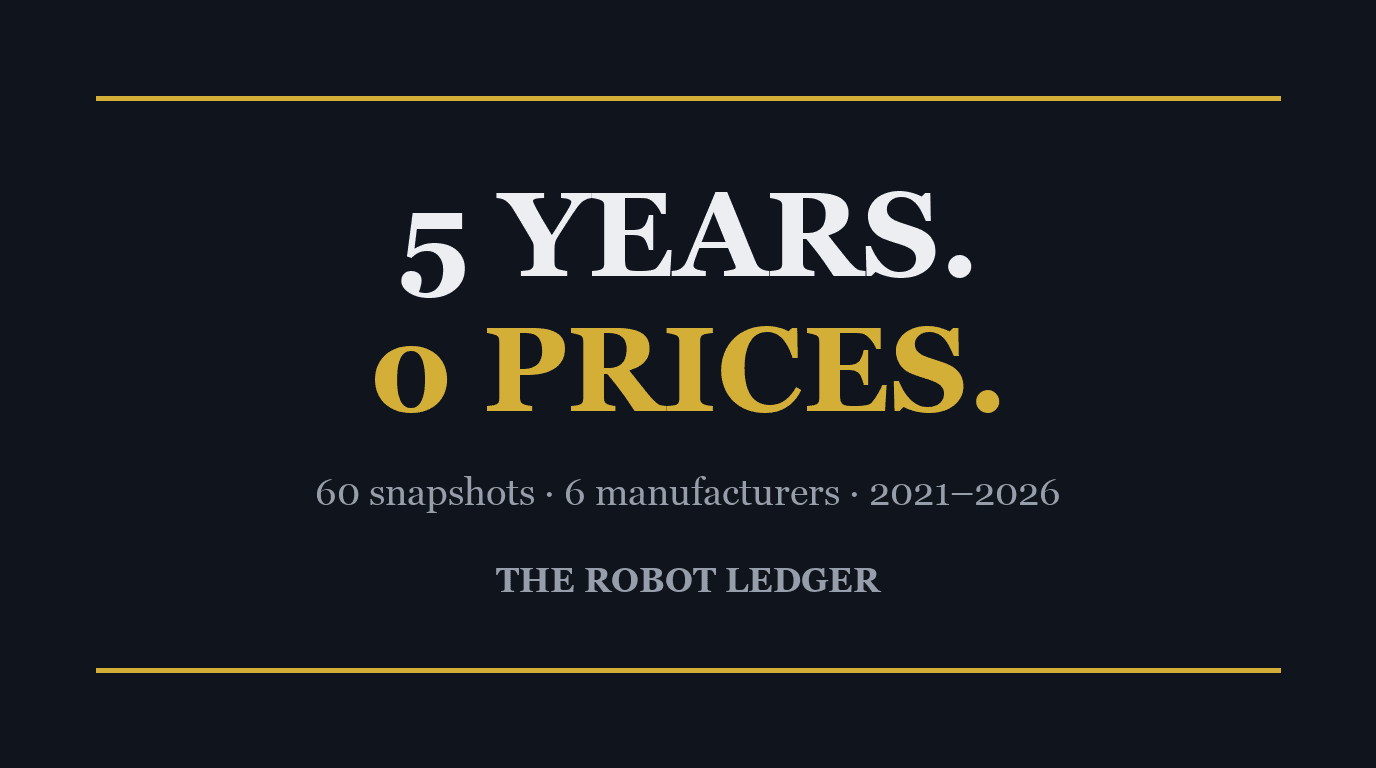
Try a simple experiment. Pick any major industrial robot arm — a cobot for a machine shop, a warehouse robot for a 3PL — and find out what it costs. Not a rough idea from a forum thread. The price.
You can't. We know, because we didn't just try it once — we tried it across five years of history.
The receipts
As part of building the Robot Frontier Price Index, we assembled an archive of the primary public pages of six major robot manufacturers across the industrial-arm, cobot, and warehouse-AMR categories — sixty snapshots spanning July 2021 through July 2026, captured from public sources and stored with checksums at the moment of capture.
Number of U.S. dollar prices published across all sixty snapshots: zero.
Not zero recently. Not zero on some pages. Zero, anywhere in the panel, for five years. Payload capacities are published to the kilogram. Reach to the millimeter. Cycle rates, certifications, case studies — everything a buyer could want except the one number every buyer needs. The industry's default interface for the most basic fact about its products is a "request a quote" form.
The pattern extends past the manufacturers. Used-equipment dealers list detailed robot inventories — quote-gated. Marketplace platforms broker robot sales — offers gated behind registration. In our entire five-year archive of these categories, exactly one U.S. dollar figure ever appeared: a robots-as-a-service provider advertising automation "for as little as $8/hour" in 2021. By mid-2022 that language was gone from its pages. It never came back.
And opacity can advance. The leading electric autonomous tractor carried a public price of $88,998 in early 2024, cut it to $74,998 by mid-year — and then removed pricing from public view entirely. Eighteen months later, it hasn't returned. A category that briefly had a visible price now doesn't.
The exception that proves it's a choice
Here's what makes the zero interesting: it isn't universal. Unitree publishes a complete public price list — every humanoid and quadruped variant, in dollars, on a store page. And that happens to be the corner of robotics where the entry price is falling in public — down 15.6% in under two years, visible to anyone, as documented in our inaugural index print. Transparency and price competition arrived together. That's not a coincidence; that's what a functioning market looks like.
Industrial robotics, by contrast, prices the way it does for familiar reasons: distributor channels that price by project and by customer, discrimination across applications and regions, and no comps ecosystem to discipline any of it. Each individual manufacturer is behaving rationally. The sum of that rational behavior is a market where nobody — not buyers, not boards, not lenders — can anchor a number without three sales calls.
Who pays for opacity
Buyers pay first: you cannot budget for what you cannot price, and every automation business case starts with weeks of quote-gathering that a functioning market would resolve in an afternoon. Boards pay next: comparing vendors without comparable prices means decisions get made on relationships and demos. Lenders pay quietly: collateral you cannot price is collateral you discount, which makes robot financing more expensive than it needs to be — a tax the industry levies on its own adoption rate.
And the industry pays last, because opacity is self-limiting. The categories growing fastest in public confidence are the ones whose economics can be checked.
What we're doing about it
Nobody inside the industry is positioned to fix this — a trade association cannot publish what its members won't, and no single vendor benefits from unilateral transparency. So the fix has to come from outside, from observed data, maintained neutrally, with receipts.
That's what The Robot Ledger is for. The Robot Frontier Price Index tracks observed prices where they exist; the price-visibility tracker, a standing feature of every quarterly print, tracks where they don't — category by category, with dates, including every time a price appears or disappears. Opacity is data. We intend to keep publishing it until that stops being necessary.
The Robot Ledger is published by Pexara AI LLC. Every figure above traces to a dated, checksummed archive entry; figures may be cited with attribution.